Company
Built for Guards, Not Police
Why private security needs body camera workflows built for guards, clients, and supervisors instead of police-first tooling.
Built for Guards, Not Police: Designing Tools for Contract Security Workflows
I spent years looking at how security companies try to make law enforcement technology work for contract guards. Good technology, talented teams - and yet it never quite fits. The tools were built for a different job.
Police body cameras exist to capture evidence for prosecution. That is a serious, important mission, and the technology that supports it is deeply sophisticated. Evidence chain-of-custody, legal discovery workflows, long-term forensic storage - all of it designed for a world where a single recording might end up in a courtroom years later.
Contract security lives in a completely different world.
A guard working a commercial property needs to document a shift, capture an incident clearly, and give their supervisor - and their client - confidence that the job got done. And when something does escalate, that footage needs to be easy to find, easy to pull, and easy to share - with the client, with an attorney, with law enforcement. The system builds trust on every shift and holds up when it really matters.
This is not a criticism of law enforcement tools. It is an observation that the daily workflow is different. The video is just as valuable when things get legal - it is just designed so that private users can navigate it themselves, pull what they need, and share it without a forensics department.
The Elegance of Simplicity
There is a version of "simple" that just means stripped down. Fewer features, fewer options, fewer capabilities. That is not what I am talking about.
Real simplicity is much harder to achieve. It means a new guard picks up the camera on day one and it just works. Not because we removed functionality, but because we designed the whole system - from the ground up - around the way guards actually work.
Think about the difference between remodeling an office into a house versus building a home from scratch. You can tear out cubicles and add a kitchen, but the bones are wrong. The hallways are too narrow, the electrical is in the wrong places, and nothing flows the way a family needs it to. Starting fresh - with the actual use case in mind from the very first sketch - gives you something that feels effortless. That effortlessness is the product of enormous care.
Simplicity is not the absence of complexity. It is complexity that has been resolved.
What Guards Actually Need
The daily reality of contract security is high turnover, tight margins, and clients who want proof of service. Technology that works in this world has to respect those constraints.
Day-one usefulness matters more than anything. A new hire needs to get real value from the system with minutes of training - not hours. If it takes a classroom session to learn the camera, adoption will fail. Not because the guards are not capable, but because the operational reality does not allow for it.
Easy access when it counts. Supervisors need fast answers - what happened, who was there, and is the client covered. And when something serious happens, anyone on the team can pull the footage, package it, and share it with a client, an attorney, or law enforcement - no special training, no forensics department required. AI-generated summaries and quick clip access mean the right people get the right information in minutes.
Shared-device models are essential. Multi-site security operations cannot provision individual devices for every guard on every shift. The system has to support shared camera pools natively - not as an afterthought bolted onto a single-user design.
Pricing has to be predictable. Flat monthly plans - per device, per site, or per user - that fit into thin margins without procurement gymnastics. If a security company needs a finance team to decode your pricing, you have already lost them.
Design That Disappears
The best design decisions are the ones nobody notices because everything just works.
One-touch recording. The primary function should never require fumbling through menus.
Auto-upload and auto-tagging. When a shift ends, footage moves to the cloud and organizes itself. No manual steps, no forgotten uploads, no admin burden.
Client-facing dashboards. The client should be able to answer their own questions about what happened on their property - without calling the security company and waiting for someone to pull footage.
Role-based defaults. The system should open ready for the most common task - logging a patrol - not the most complex one. A guard starting their shift should see exactly what they need. Nothing more, nothing less.
During our field work, something became very clear very quickly. Guards do not resist technology. They resist friction. When the tool fits their actual day - when it helps instead of slowing them down - they use it. Willingly. Even enthusiastically.
The Real Test
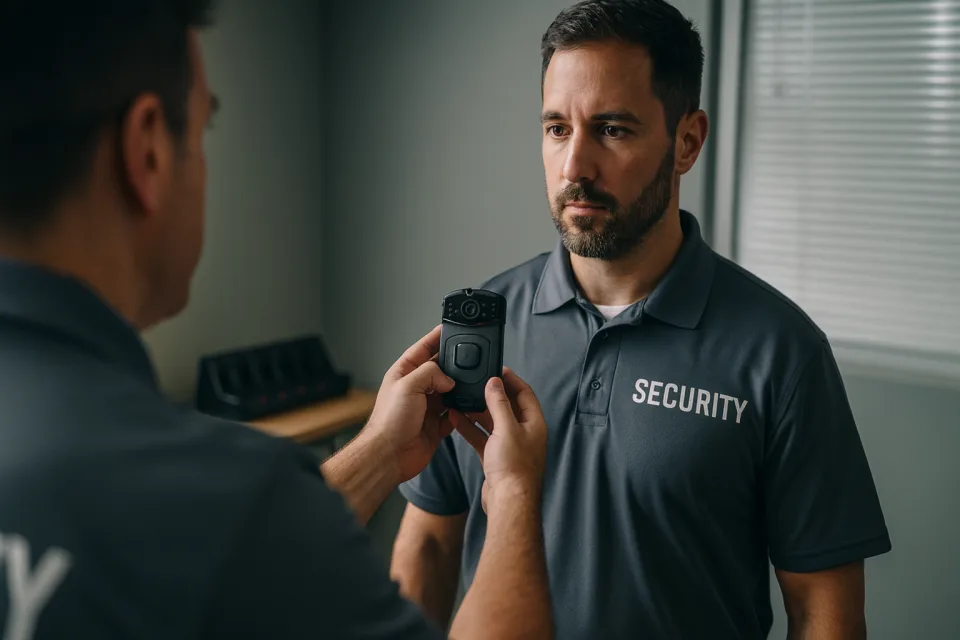
The simplest measure of whether security technology was built for the right job is this: hand it to a new guard on their first day and watch what happens. If they are productive within minutes, the design is working. If they need a manual, a training class, or a workaround - the tool was built for someone else's mission.
Contract security deserves technology designed with the same care and precision as law enforcement tools - just pointed at a different target. Operational clarity. Client confidence. Guard adoption from the very first shift.
That is what we are building.
Where to go next
See how this thinking shows up on the security guard body camera page, compare the lower-profile AI badge camera option, and review the evidence posture in the enterprise readiness center.