Founders
Coming Out of Stealth - What We've Been Building and Why
I've been quiet for two years.
I've been quiet for two years. Not retired - building. And now it's time to talk about it.
Those who know me know I shifted from CEO to chairman at Sphero in 2020 and my wife Renee and I went and lived out my dream - we moved onto a Nordhavn trawler. Four years. Rhode Island, up and down the East coast, to every corner of the Caribbean, and all the way down to Trinidad. It was everything we hoped it would be.
But by mid-2023, the startup bug was back. If you've started companies before you know the feeling - you are compelled to try it again and build something bigger and better than before.
I began brainstorming with my brother-in-law Steve Tomsic. Steve and I have worked together in several businesses over the years and we've always worked well because we come at problems from different angles. I’m the product guy and he’s the sales and ops talent. We were watching the AI revolution unfold in real time and asking the same question every startup junkie was asking - where can this actually make a difference?
The answer came from the usual place - past experiences.
In late 2019 I co-founded a spin-out from Sphero called Company 6. We were building a soda-can sized robot for law enforcement situational awareness. It didn't make it, but it taught me a lot about how physical security and safety tech actually works in the real world. Steve, at the time, was building software for private security companies so he knew their problems. Between us we knew an industry that was massive, essential, and running on tools from the last decade.
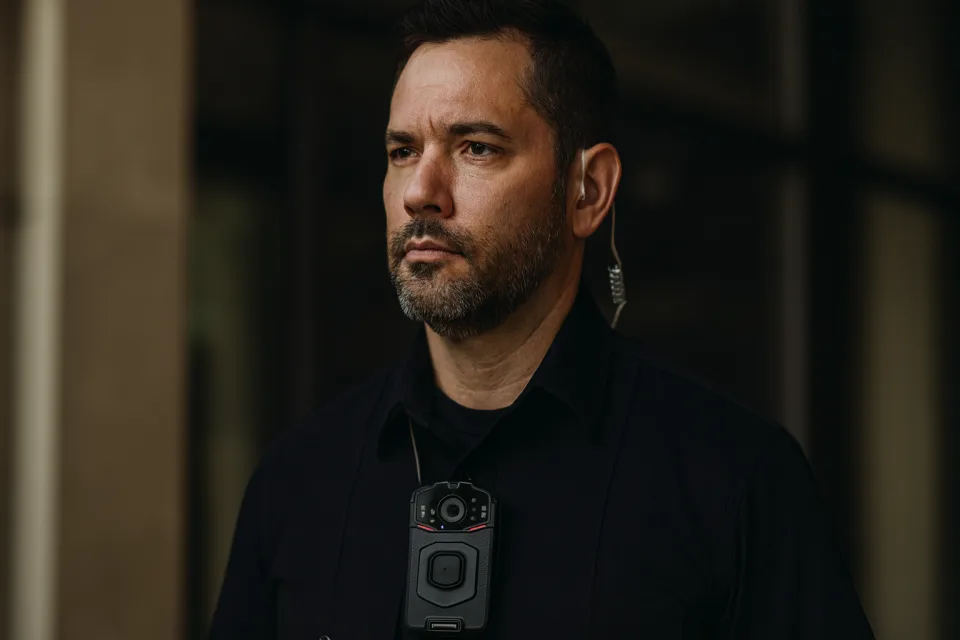
The idea was simple - help security guards do their jobs better with AI. Body cameras powered by artificial intelligence, purpose-built for private security. Not law enforcement hand-me-downs. Not consumer phones or cameras strapped to a uniform. Something designed from scratch for guards and the companies that employ them.
But the real question wasn't whether we could build it - it was whether AI could actually help enough to matter. Writing an award-winning novel is a high bar for AI. But what's the bar for helping a security guard write a better incident report? For keeping a guard engaged on an 8-hour overnight shift? For giving a client actual proof the job was done right?
We thought the bar was reachable - and the impact could be enormous.
So we started digging. We brought on some of my colleagues from Sphero. Could we find a hardware platform? Could we get an AI to do meaningful work in real security scenarios? We dabbled. We tested. We talked to private security companies - a lot of them. Wrote some code, found a hardware partner for body cameras, and by May 2024 it was clear we could make a real difference.
We also knew what we didn't want to be. Other companies were starting to look at basic transcription and report-writing tools. Useful, but incremental. We wanted to go all-in. AI-first. Push the capabilities and limits with no baggage and no legacy to protect. We purposely didn't want to copy anyone - we wanted a clean, simple, industry-specific solution.
But here's the thing about mid-2023: the AI was promising but not ready. GPT-3.5 and early GPT-4 could handle text well but image analysis wasn't there yet. The leap we envisioned needed the tech to catch up. So I traveled, stayed connected, kept researching and testing, and saw the world after we sold the boat in May 2024.
Then Hong Kong happened.
I went to a doctor for what I thought was routine heart check. After reviewing my test results the doctor came running to the elevator as I was leaving the office (would that ever happen in the US) - I needed a new aortic heart valve. Immediately.
Everything stopped. I got laser-focused on getting healthy. And in one of those strange full-circle moments, AI helped me do it. I uploaded my medical images, did deep research, and found a surgeon in Texas who could do the procedure in a minimally invasive manner. Three days after surgery I was recovering and already thinking about what came next.
That experience didn't change what I wanted to build. It confirmed it. I'm not built for retirement. Breaks recharge me - but I need to be building something. The tech was inspiring and the opportunity to make a difference was too compelling to dream of stopping.
My team was ready. Steve in Phoenix, colleagues working from Hong Kong. I moved to Phoenix to be close to Steve, we brought on two other tech co-founders in Washington and we were off building the vision.
This time I wanted to do things differently. My second company was fully bootstrapped - it was a nice exit early in my career and honestly some of the most fun I've had building anything. I wanted that feeling again. No big raise, no board meetings, no inflated headcount, no external pressure to perform on someone else's timeline. Just a small team with extraordinary talent, self-funded, moving fast (at least for now - perhaps in a bit we will look for investors).
Could we build something meaningful with just our own effort and capital? That is the goal.
We stayed quiet for one simple reason: focus. I believe an awesome product sells itself. And building awesome AI plus hardware for an industry that desperately needs simplicity is genuinely hard. It requires incredible talent. People who can adapt to AI's relentless pace of change, who care about the craft, and who don't need a press release to stay motivated.
Having to explain what you're doing to the world every week, or manage the expectations of investors watching a burn rate - I've done that. Several times. It works but it has a cost. This time I chose focus over visibility.
So here we are. The product is real. The team is exceptional. Early results from customers are coming in and they're validating everything we believed when this was just an idea on a boat in the Caribbean.
It's time to tell the world about PATROL6.
If you want a public timestamp for that launch, I also shared the story in this LinkedIn launch post.
This is startup number eleven for me. And I'm going to do something I haven't done before - share the journey as it happens. The wins, the hard parts, what I'm learning about AI and hardware and an industry most tech people have never looked at twice.
Hopefully number eleven is a fun ride. I'm learning a ton already.
More to come.
Full transparency. I use AI in all aspects of my life. This post is written by me but I use AI to help me edit, organize my thoughts, correct my grammar and format for clarity. It's a huge time saver but it's not a replacement for my voice, and I'll never post without ensuring it's true to what I wrote. If you aren't using AI to help you write better and clearer, you should. It makes it easier for your reader. Going forward you can assume the same from all my posts.