Founders
Everyone Has the Same Ingredients — Only the Best Chefs Will Win
I've been in fast rivers before. Those were creeks. What's happening right now with AI — this is the Amazon River on a Class 5 rapid.
I've been in fast rivers before.
The late nineties into the early 2000s — the internet explosion, bandwidth proliferation, watching an entire economy rewire itself in real time. Then the 2010s — Web 2.0, the connected everything era, platforms eating the world. Then crypto showed up and for a minute that felt like the fastest current I'd ever been in.
Those were creeks. Pleasant little creeks with maybe a Class 2 rapid here and there.
What's happening right now with AI — this is the Amazon River on a Class 5 rapid. Everything, everywhere, always changing, always accelerating. And I don't mean that as a figure of speech. I mean the pace of change in the last eighteen months has made every previous technology wave I've lived through feel like a warm-up.
Here's how I think about who's experiencing this. Maybe twenty percent of people — probably less — are actually in the river. They feel the current. They're building with AI daily, adjusting weekly, watching their own workflows transform in ways they didn't predict a month ago. Another group is standing on the riverbank — they can see it moving, they read about it, they use it to ask questions, talk about it at conferences. And then there's the rest of the world, for whom AI is just another tech thing that's always in the news. Like blockchain was. Like the metaverse was. Background noise.
I'm in the river. I'm not sure I'm in the swiftest part — I'm not even sure where that is right now because the topology keeps changing. But I'm in it. And even from where I sit, the speed is stunning.
Everyone keeps saying this time is different. At first I pushed back on that. I've heard "this time is different" before — usually from people who weren't around for the last time. Every wave feels unprecedented when you're in it. So I treated AI the way I've treated every new tool: useful, powerful, worth learning, but ultimately just another instrument in the kit.
I was wrong. Or more precisely — I was right for about six months, and then the ground shifted.
It wasn't a single moment. It was cumulative. One week an agent helped me draft something that would have taken a day. The next week a different tool restructured a dataset in minutes that would have taken an analyst a week. Then I watched our engineers build in a sprint what used to take a quarter. And somewhere in that accumulation, the framing flipped. This isn't just another tool. This is a different kind of company building process entirely.
So now the race is on. And the terms of the race have changed.
In every previous wave, the companies with the best developers won. If you could afford the talent — the engineers who understood distributed systems or mobile architecture or whatever the scarce skill was at the time — you had an edge. You could outpace the companies that couldn't recruit or couldn't pay. Talent was the bottleneck, and access to talent was the differentiator.
That equation just broke.
Today, if you're technically minded and you can manage and delegate to AI agents, the speed at which you can move is almost absurd. I'm in the river and I'm still amazed by it. The tools are available to everyone. The models are available to everyone. The APIs, the frameworks, the infrastructure — all of it, accessible to anyone with a laptop and curiosity.
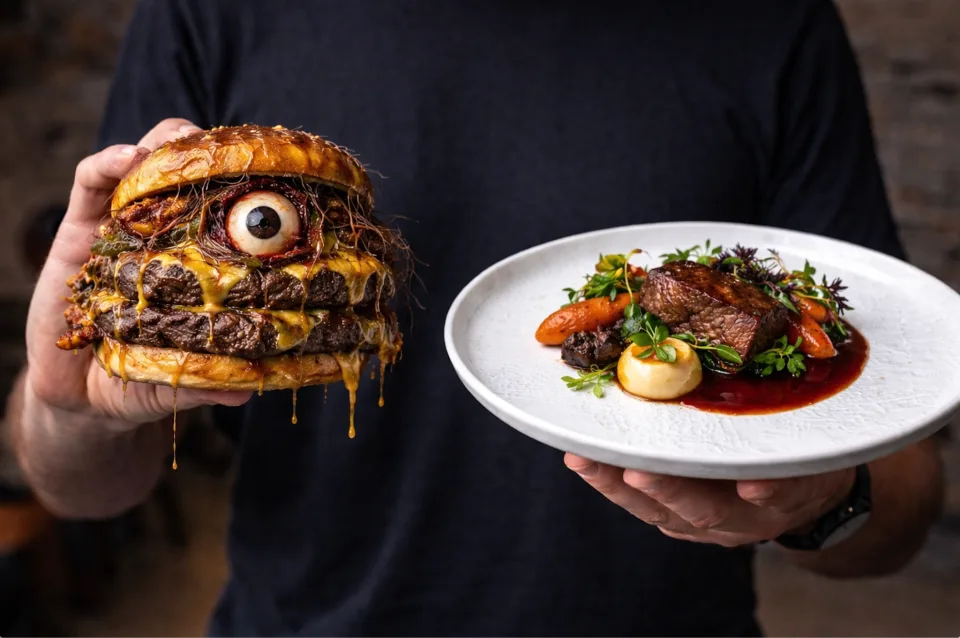
It's like all the food in the world just became free. Every ingredient, every kitchen appliance, every technique — available to everyone at the same time. So what determines who wins? The chef. The person who knows what to make, why to make it, and how to combine the ingredients into something worth eating. Some people will create Michelin three-star meals. Others will turn out a greasy hamburger that's twenty-two percent lean. Same ingredients. Same kitchen. Wildly different outcomes.
Let me give you a real example — because I know some of you reading this are nodding and others think I'm exaggerating.
A few weeks ago, I had an AI agent build a sophisticated CRM tool for PATROL6. Not a toy. A fully functional system with authenticated user access, administrative panels, multi-user permissions for people outside our organization, and a sales pipeline tailored to our specific go-to-market structure. Then I told it to find every private security company in the United States and load them into the CRM. Identify their key contacts. Get me their email addresses. Then evaluate each company against a ten-step algorithm I designed to predict the likelihood they'd buy our service — and score them from one to a hundred.
A few days later — with some back and forth, some testing of the algorithm, some refinement of the scoring model — it was done. Over six thousand companies. Identified, with verified contacts, evaluated, scored, and organized in a custom-built system designed around our exact sales process.
Think about what that would have cost two years ago. A CRM buildout alone — custom, multi-tenant, with external access and admin controls — that's a serious software project. Buying or renting a targeted email list for an entire industry vertical? Expensive. And the evaluation piece — scoring six thousand companies against a proprietary algorithm? That's a sharp intern working full-time for an entire summer, if they're good. Maybe two interns. Maybe a junior analyst and an intern.
I did it in days. With agents. While also running a company.
That's not a productivity improvement. That's a category change.
So what does this mean for how companies are built? It means the scarce resource isn't the ability to code anymore. It's the ability to think. To architect. To figure out what to build and why to build it. The how — we all have the how now. There's no differentiation in execution mechanics when everyone has access to the same tools.
You don't need an army of line cooks. You don't need a brigade of garde mangers prepping mise en place for twelve hours. You need chefs. People with ideas, taste, judgment, and the ability to orchestrate AI agents the way a conductor leads an orchestra — knowing when to bring in the brass, when to let the strings carry it, when the whole thing needs to swell.
Talent still matters. It might matter more than ever. But the definition of talent just changed. You need people who can multitask across agents, who think in systems, who can look at a problem and see the architecture before a single line of code gets written. You need builders who are also designers. Engineers who are also strategists. People who understand that the competitive advantage isn't in having the tools — it's in knowing what to do with them. It's about unleashing them in a systematic way with a plan that allows you to scale and still be accountable for the results otherwise it will just be chaos.
At PATROL6, this is how we're built. Small team, AI-native from day one, moving at a pace that would have required five times the headcount three years ago. And if what I can build with agents is any indication — what our actual engineers are producing is staggering.
The ingredients are nearly free. The kitchen is open. The question is whether you're cooking something worth eating.
Paul