Founders
Why Private Security? Why Now? Why Me?
Why PATROL6 chose private security as the wedge for AI body cameras, automated reporting, and operational proof.
A few years ago I cofounded a company called Company 6. The idea was a small, low-cost, soda-can-sized throwable robot that could give law enforcement officers situational awareness before they put themselves in harm's way. Know what's around the corner before you walk into it. The company didn't make it. Covid killed the timing, the underlying tech was too immature, and the funding dried up.
But I learned something that stuck with me. I heard from people whose entire job is to protect others. How they think, what they worry about, what tools they actually use versus what they wish they had. Private security was on our radar as an expansion market but it wasn't our focus. I filed it away.
Fast forward to mid-2023. My brother-in-law Steve Tomsic and I are brainstorming what to build next. Steve had spent time building software for private security companies, so he knew the industry from the inside. He started walking me through the problems and the more I listened the more I realized how big the gap was between what these companies need and what they actually have.
Here's what Steve explained. A security guard has three core jobs: observe, report, and deter. Simple in theory. But the reporting piece eats the job alive. Even with a decent app, a guard has to stop what they're doing, remember everything that happened, get the details right, input it all manually, and then get back to being present and aware. That's a lot of cognitive load for someone who's supposed to be focused on what's happening right now. Steve said something I haven't forgotten: if there was a way to automate all of that and just let guards focus on the moment of being present and helping people, it would make the job easier, more enjoyable, and deliver better results for everyone.
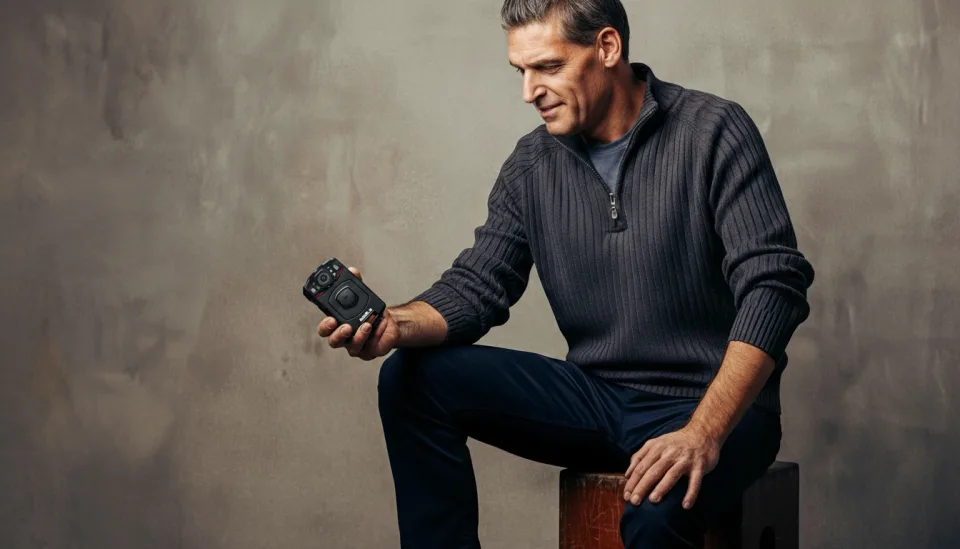
I thought a body camera could be the answer. Not as a surveillance tool. As an AI-powered assistant that watches, listens, and handles the paperwork so the guard can do the actual job.
The timing made it real. In mid-2023 the top models were GPT-3.5 and GPT-4. They were impressive with text but couldn't process images yet. That was the missing piece for us. I started experimenting with some light Python code and other tools to test whether we could get images from a body camera analyzed by AI and turn them into reports. It wasn't there yet, but the pace of improvement was obvious. By late 2023, GPT-4 got vision capabilities. Then in May 2024, GPT-4o arrived and the game changed. Every few months the models got meaningfully better. We knew the tech would catch up to the vision if we started building now.
So why has innovation in private security been so slow compared to law enforcement? The answer is simple: money.
There are over twice as many private security personnel in the US as law enforcement officers. In some countries it's four or five times as many. But the economics are completely different. Law enforcement is funded by taxpayers. Police departments access public budgets, and while they care about price, the decision is ultimately about public safety and accountability. Those budgets rarely decrease. That's a great industry to serve if you're a tech company, and several multibillion-dollar companies have built massive businesses doing exactly that.
Private security is all about the bottom line. Every dollar of technology has to make economic sense in a business that runs on thin margins. No tool gets adopted unless it makes the people using it demonstrably better at their job and makes the company more profitable. That's a much harder sell, and it's why most tech companies have ignored this space. The money isn't as easy, the customers are more price-sensitive, and the market is incredibly fragmented. Most private security companies are regional. They specialize in different verticals like executive protection, retail, industrial, office buildings, HOAs, oil and gas, manufacturing. Each has its own nuances. But at the end of the day they all have the same core functions: observe and report.
That fragmentation is actually what attracted us. Less tech innovation means less competition. A niche with tight margins and operational complexity isn't where venture-backed startups rush in. But for a small, self-funded team with deep hardware and software experience, it felt like a perfect fit. We wanted a moat, and hardware gives us one. Hardware is hard, as the saying goes. Our approach doesn't eliminate the hard part but it buys us time to develop while the AI tech continues to evolve, without racing every other software-only AI startup.
And we have a clean slate. No legacy product to maintain. No existing customers expecting the old way to keep working. Just a commitment to make AI work for guards, not replace them. As I always say, there are very few unique ideas out there, just good and bad execution. The big players will eventually try something, but starting from zero with an AI-first architecture and no baggage is a real advantage when the underlying technology is changing this fast.
Why me? I've started ten companies before this one. The pattern I keep coming back to is that the best opportunities are in industries where technology is 10 or 15 years behind, where the existing players are comfortable, and where someone from the outside can see what the insiders stopped noticing. Private security checks every one of those boxes.
The early feedback from customers has been better than expected. The time is right, the opportunity exists, it's a messy problem to solve, and it's hard. All stuff I love.
I also shared a shorter version of this thesis on LinkedIn, because the more people who understand why private security is the right wedge, the easier it is to explain what PATROL6 is actually building.
And here's what excites me most: there are dozens of other industries where a device that can watch, observe, guide, and report could make a real difference. But that's down the road. Right now the focus is private security, and there's plenty of work to do.
Where to go next
If you want to see the product direction behind this thesis, review the AI body camera page, compare the AI badge camera option, and read why AI is splitting private security in two.